Saturday, July 6, 2013

Osprey

        Today's featured feathered friend is the Osprey.  The Osprey is the second most widely distributed raptor species on earth, behind the Peregrine Falcon.  They are found in temperate and tropical regions of every continent except Antarctica.  It is sometimes referred to as a sea hawk, a fish hawk or a fish eagle.  The Osprey is the provincial bird of Nova Scotia, Canada.
        Ospreys are long-winged hawks with short slender bodies.  They are dark brown above and white below.  Ospreys have small white heads with a broad brown eye stripe.  Their yellow eyes are large and piercing.  Their narrow wings are mostly white with a prominent dark patch at the wrists.  They average between 21 and 24 inches in length, between four and six pounds in weight and their wingspan averages between five and six feet.  In breeding pairs, females are visibly larger than males.  Juveniles have white spots on the back and buffy shading on the breast with reddish-orange eyes.
        The Osprey's diet is almost exclusively live fish and they are very skilled anglers.  They can spot a fish from heights of over 100 feet above the surface of the water.  Once they have selected a target, they will hover for a moment and then dive feet first into the water to snatch the fish.  They are not fussy eaters and will take any fish, usually between 10 and 14 inches long and weighing less than 12 ounces.
        Click on the links below to learn more about this fascinating raptor and enjoy these photo of the Osprey.....tweet.....tweet!!

Posing in a tree.
(Taken 6/30/12, Sports Complex, Englewood FL)
Adults at the nest. (male left, female on right)
(Taken 2/27/13, Oyster Creek Regional Park, Englewood FL)
 
Juveniles on the nest.
(Taken 4/24/12, Sanibel Island FL)
 
Up close and personal
(Taken 1/2/13, Parrish Park, Titusville FL)
Flying away with it's catch.
(Taken 1/1/13, The Celery Fields, Sarasota FL)


Wednesday, June 26, 2013

Loggerhead Shrike

     Today's featured feathered friend is the Loggerhead Shrike.  Although they lack the size, strong feet and talons of a raptor, this striking songbird has a raptor-like attitude.  They capture and consume lizards, mice and smaller birds as a part of their diet.  They impale their prey on thorns or barbed-wire fences, ripping them apart with their thick, hooked bill. 
     Loggerhead Shrikes are 9 inches in length with a 13 inch wingspan, weighing only 1.5 ounces.  They have gray heads and backs,  white underparts, with black wings and tails.  They have a white patch on each wing and their outer tail feathers are white.   A black face mask gives them a distinctive "bandit" look.  Adult females are slightly darker than males.  Juveniles are similar to adults but are a paler gray.  Their coloring is similar to that of the Northern Mockingbird and the Northern Shrike.
     Of the 31 Shrike species worldwide, the Loggerhead is the only one endemic to North America, meaning, they can't be found anywhere else on earth.  Enjoy these photos of the feisty Loggerhead Shrike.....tweet.....tweet!! 
 
(Taken 2/10/13, Ft. Desoto Park, St. Petersburg FL)
 
(Taken 5/1/13, The Celery Fields, Sarasota FL)
 
(Taken 11/8/12, Bluefield Ranch Natural Area, St. Lucie County FL)
 
 
(Taken 12/13/12, Laurel FL)

http://en.wikipedia.org/wiki/Loggerhead_Shrike

Tuesday, June 18, 2013

Great Crested Flycatcher

     Today's featured feathered friend is the Great Crested Flycatcher.  It is among the most abundant of the flycatcher species, which includes Pewees, Phoebes and Kingbirds.
     Males and females are similar in appearance.  This medium-sized flycatcher has a slim body, a large head with a big bushy crest and a large bill.  It has warm brown upperparts, a gray lower face, throat, and upper breast with a bright yellow belly.  They measure about eight inches in length, weigh almost 1.5 ounces and have a wingspan of around 13 inches.  They also have two narrow white wing bars on each wing.
     Like most flycatchers, their diet is predominantly insects, but they also eat fruits and berries.  They usually hunt at tree top levels (the canopy).  They will perch on a limb, fly out to catch an insect in mid-air and then return to the same perch.  They are rarely found on the ground.
     On it's summer range, they can be seen from the east coast to the Rocky Mountains and in the southern parts of several Canadian provinces.  In the winter, they migrate south to Mexico, Cuba, Central America, the Caribbean and the northernmost parts of South America.
     Enjoy these photos of the Great Crested Flycatcher.....tweet.....tweet!!  
 
Great Crested Flycatcher
(Taken 4/19/13, Coquina Baywalk at Leffis Key Preserve)\
(Anna Maria Island FL)
 
Great Crested Flycatcher
(Taken 3/21/12, in our neighborhood)
 
Great Crested Flycatcher
(4/28/13, Our Backyard)
 
http://www.allaboutbirds.org/guide/Great_Crested_Flycatcher/id

http://en.wikipedia.org/wiki/Great_Crested_Flycatcher

Tuesday, June 4, 2013

Carolina Wren - A Little Bird with A Big Voice

     Today's featured feathered friend is the Carolina Wren, the state bird of South Carolina.  They are heard in our backyard almost every day, but they are rarely seen.  This shy bird is only 5/1/2 inches in length and weighs just over half an ounce.  What it lacks in size, it makes up for in voice, delivering an amazing number of decibels.  It's loud, teakettle-teakettle-teakettle call, can be heard all across the eastern half of the United States.  Although females also vocalize, only the male sings the loud song.
     Carolina Wrens are small, chunky birds with a round body and a long tail that is often cocked upward.  They are bright reddish-brown above and warm buffy-orange below.  They have a long white eyebrow stripe, a white chin and throat, with a long, slender, down-curved bill.  Males and females are similar in appearance. 
     Carolina Wrens do not migrate.  As a result, their numbers decline dramatically during severe winters.  However, they are prolific breeders and with as many as three broods per year, their numbers return to normal levels rather quickly.
     Enjoy these photos, all taken in our backyard.....tweet.....tweet!!


http://www.allaboutbirds.org/guide/Carolina_Wren/id

http://en.wikipedia.org/wiki/Carolina_Wren

Saturday, May 25, 2013

Swallow-Tailed Kite

     Today's featured feathered friend is the Swallow-Tailed Kite.  With it's "scissor-tail" and distinctive black and white plumage, it's presence is exciting and unforgettable.  It's head and body are white, it's wings, tail, feet and bill are black.  It's tail alone is over a foot long.  Adults and juveniles are similar in appearance, although younger birds have shorter tails.  Their average length is 23 inches, their average wingspan is 48 inches and their average weight is slightly more than one pound.
     These striking raptors are native to South America, but many migrate to the United States each spring for a breeding season which takes place from March to May.  They can be found in all of the Gulf Coast states and as far north as the Carolinas.  In late summer and early fall, as many as 2,000 birds gather together in the same place (a staging area) before heading south for the winter.
     Swallow-Tailed Kites are very fascinating birds.  They rarely flap their wings in flight, however, they constantly rotate their tails to maintain a heading or to make sharp turns.  They glide low over water and then skim the surface with their bill to get a drink.  They sometimes eat while in flight.  Their call is more like that of a songbird than a raptor, yet they are mostly silent.
     This graceful bird was chosen as the symbol for The Great Florida Birding Trail (GFBT).  It's image adorns road signs state-wide, signifying stops along the Trail.  The GFBT is a network of over 500 sites throughout Florida selected for their excellent birdwatching, wildlife viewing or educational opportunities.
     The Swallow-Tailed Kite certificate (Level 5, Elite) from the Wings Over Florida Program is the highest level that can be reached.  It is awarded after a birder scores 350 Florida species.  We are now less than 50 birds away from reaching our Level 3 (Advanced, 250 Florida species) certificate.
     Click on the links provided for more information about the Swallow-Tailed Kite and the GFBT.  Enjoy these photos taken from our backyard.....tweet.....tweet.
 
Swallow-Tailed Kite
(Taken 6/3/12)
 
Swallow-Tailed Kite
(Taken 5/10/13)


GFBT Road Sign found throughout Florida
http://www.allaboutbirds.org/guide/Swallow-tailed_Kite/id

http://en.wikipedia.org/wiki/Swallow-tailed_Kite


Friday, May 17, 2013

Black-Bellied Plover

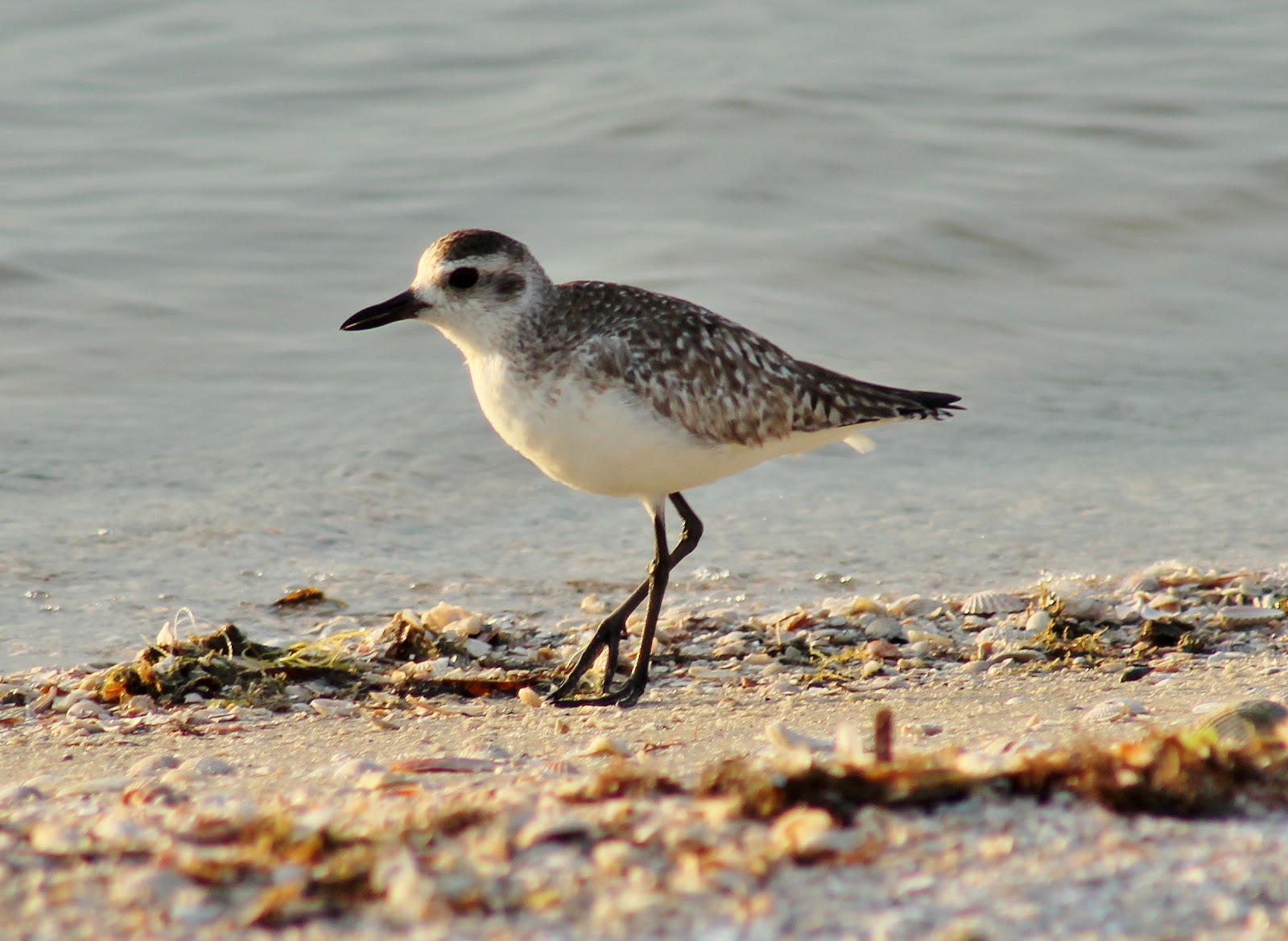
     Today's featured feathered friend is the Black-Bellied Plover.  Also known as the Gray Plover, it is the largest plover in North America.  Their average length is 11.25 inches, the average wingspan is 23.5 inches and they weigh between 6 and 9 ounces.
     Black-Bellied Plovers molt into their non-breeding (winter) plumage by early September and retain it through the following April.  Their winter plumage is a fairly plain gray above, with a gray speckled breast and a white belly.  In spring and summer, they change back into their breeding (summer) plumage.  Adult males have a striking black neck, throat, breast and upper belly.  The black contrasts  with a vivid white stripe running down the sides of the neck to the wings, the rump is bright white.  Adult females can be just as colorful or much more subdued.  Juveniles and first year birds resemble adults in winter plumage.    
     Black-Bellied Plovers are long-distance migrants, making non-stop flights over Asia, Europe and North America.  However, they are rarely seen in the interior of these continents, landing only if forced down by severe weather, or to feed on the shores of very large lakes.  Their summer breeding grounds are in the Arctic areas of Canada, Alaska and Russia.  When not on their breeding grounds they are abundant on coastlines around the world.
     Enjoy these photos of the Black-Bellied Plover.....tweet.....tweet!!

In Summer (Breeding) Plumage
(Taken 5/16/13, Boca Grande Beach, Gasparilla Island FL)

In Winter (Non-Breeding) Plumage
(Taken 2/7/13, Indian Mound Park, Englewood FL)

Changing into Summer (Breeding) Plumage
(Take 4/11/13, Ft. Desoto Park, St. Petersburg FL)


In Summer (Breeding) Plumage
(Taken 5/16/13, Boca Grande Beach, Gasparilla Island FL)
 http://www.allaboutbirds.org/guide/Black-bellied_Plover/id

http://en.wikipedia.org/wiki/Grey_Plover

Saturday, May 11, 2013

Bachman's Sparrow

     Today's featured feathered friend is the Bachman's Sparrow.  Although a year round resident, determining their presence in the winter is difficult because of it's seclusion and inactivity.  However, in the spring they are very active.  Breeding season usually starts in March lasting through mid-summer.  That's when breeding males can be seen singing from low and exposed perches.  
     It is a large sparrow with reddish-brown and gray streaked upperparts, with buffy underparts contrasting with a whitish belly.  It's face is gray with a brown crown and a thin dark line extending back from it's eye.  The tail is long, dark and round-tipped.  It's legs and feet are pink.  Males and females are similar in appearance.  Juveniles are like adults but with black streaking on the breast and crown.
     The Bachman's Sparrow is endemic to the southeastern United States, meaning, they can't be found anywhere else on earth.  Their range includes Virginia to Missouri in the north, parts of eastern Texas to the west, as well as all of the Atlantic and Gulf coast states.  Birds in the northern parts of this range migrate south for the winter.  Their conservation status is Near Threatened, with habitat loss as the biggest factor cited for it's declining population.
     We had read of sightings as early as February this year at the Babcock-Webb WMA, south of Punta Gorda.  On May 10th, we made the short trip and scored our 203rd Florida bird.  Enjoy these photos (and a video) of the elusive Bachman's Sparrow.....tweet.....tweet!! 

Click here for the video---->   http://youtu.be/obmocEMeiRM

Bachman's Sparrow
(Very first photo of our 203rd Florida bird)
 
Bachman's Sparrow singing a beautiful song.
http://en.wikipedia.org/wiki/Bachman's_Sparrow

http://myfwc.com/viewing/recreation/wmas/lead/fred-babcockwebb/wildlife/