Friday, February 22, 2013

Wings Over Florida

     On December 27th 2012, on an outing to the Celery Fields in Sarasota, we spotted the Sora.  Finally, we had scored our 150th Florida bird and earned our "Scrub-Jay" level certificates from "Wings Over Florida". 
     The Florida Fish and Wildlife Conservation Commission (FWC) administers the Great Florida Birding and Wildlife Trail (GFBWT).  This 2,000-mile, self-guided highway trail features over 500 sites covering the eastern, western, southern and panhandle sections of Florida.  We have visited over 40 of these Birding Trail sites and countless other parks, lakes and ponds.  
     The Birding and Wildlife Trail oversees the Wings Over Florida program.  Birders can sign-up for free, print a checklist of Florida's birds, grab the necessary gear (survival, optical and digital) and start having fun.  Beautiful, frameable certificates are awarded at five different levels of achievement.  We had already photographed more than 80 species when we signed up for the program, so we applied for and received our "Cardinal" level certificates right away.  In just over two years, we now have over 170 species of Florida's birds on our list.  We are well on our way to the next level, the "Black-Skimmer" level, which requires 250 Florida birds. 
     Our next planned outing is to the Stormwater Treatment Area 5 (STA-5), south of Lake Okeechobee early next month.  We're hoping to score at least five life list birds on the trip.  Click on the links below to visit the FWC, GFBWT and Wings Over Florida websites for additional information.  Enjoy some of our photos taken along the trail.....tweet.....tweet!!

Our Wings over Florida Certificates
"Cardinal" Level - 50 Florida Birds
"Scrub-Jay" Level - 150 Florida Birds
SORA  -  Our 150th Bird Scored
 
Looking for a new species at Oyster Creek Regional Park
in Englewood FL.

 Searching for the rare Florida Scrub-Jay in
 Shamrock Park, Venice FL.

http://myfwc.com/

http://www.floridabirdingtrail.com/

http://floridabirdingtrail.com/index.php/resources/wings/


Thursday, February 14, 2013

Love Birds ~ Happy Valentine's Day

     In honor of Valentine's Day, our featured feathered friends are Love Birds.  Mating season is already underway.  Rookeries throughout Florida are filled with nesting Herons and Egrets.  Bald Eagles and Great Horned Owls are already raising their chicks.  Songbirds are carrying materials out of the yard to build their nests.  Cardinals and Mockingbirds are in full song searching for a mate.    
Today, we embrace Love.  Enjoy the Love Bird photos.....tweet.....tweet!!  Happy Valentine's Day.

Northern Cardinals
(Taken 6/30/11, Our backyard)

Florida Scrub-Jays
(Taken 3/24/12, Our backyard)
  
Great Blue Herons
(Taken 2/2/12, The Rookery, Venice FL)


Wednesday, February 6, 2013

Brown Pelican

     Today's featured feathered friend is the Brown Pelican.  Although a large bird by any measure, it is the smallest of the world's eight Pelican species.  The American White and the Brown are the only Pelicans native to North America.  The Brown Pelican is the state bird of Louisiana.
     Once a threatened species, Brown Pelicans are now abundant on both U.S. coastlines with a large population in the Gulf of Mexico.  They can also be found along the coastlines of Mexico, the Caribbean Islands, Central America and the northern parts of South America.
     The Brown Pelican is a large water bird with a long bill (up to 13 inches) and large pouch typical of Pelicans.  They are between 42 and 54 inches long, weigh from six to twelve pounds and have a wingspan of up to eight feet.  Males and females are similar in appearance with brown bodies and white heads.  The head, neck, bill, pouch and eye color can vary with season and breeding status.  Juveniles are similar to adults, except with brown heads.
     Unlike American White Pelicans who "corral" their food, Brown Pelicans dive head first into the water to feed.  They are graceful fliers and often form long, single-file lines, gliding just inches over the surface of the water.  Click on the links below for more information and enjoy these photos of the Brown Pelican.....tweet.....tweet!!

Brown Pelican (Adult)
(Taken 2/16/11, Placida FL)

Brown Pelican (Juvenile)
(Taken 1/26/13, Lemon Bay, Englewood FL)

Brown Pelicans diving for food.
(Taken 12/15/12, Anna Maria Island FL)
 
American White Pelican and Brown Pelican
(note the size difference)
(Taken 12/15/12, Anna Maria Island FL)
http://www.allaboutbirds.org/guide/Brown_Pelican/id

Sunday, February 3, 2013

American White Pelican

     Today's featured feathered friend is the American White Pelican.  Of the eight Pelican species on earth, only the Brown and the American White are native to North America.  
      The American White Pelican is a large white water bird with a long bill (nearly 12 inches) and a large pouch typical of Pelicans.  Males and females are similar in appearance although males are generally larger.  Their overall length (tip of bill to tip of tail) is from 50 to 70 inches and they weigh between 10 to 20 pounds.  Their eight to ten foot wingspan makes them the second largest flying bird in North American, behind the California Condor.  Their black wing tips are only visible in flight.
     Their summer breeding grounds are west of the Mississippi River to the Pacific Northwest, from Colorado to northern Canada.  In the winter they migrate to parts of California,  Arizona, the Gulf Coast states and south to Panama.  They begin arriving for the winter in our area by late October and start returning north by early April. 
     Unlike Brown Pelicans who feed by diving head first into the water to catch fish, American White Pelicans mostly feed in cooperative groups.  They form lines or circles, pushing or driving fish into shallower water, then duck their heads into the water to catch the fish.  Enjoy these photos of our largest wintering bird, the American White Pelican.....tweet.....tweet!! 

American White Pelican making a water landing.
(Taken 12/15/12, Coquina Baywalk on Leffis Key, Anna Maria Island FL)

American White Pelicans in a feeding formation.
(Taken 1/4/13, Ackerman Park, Sarasota FL)

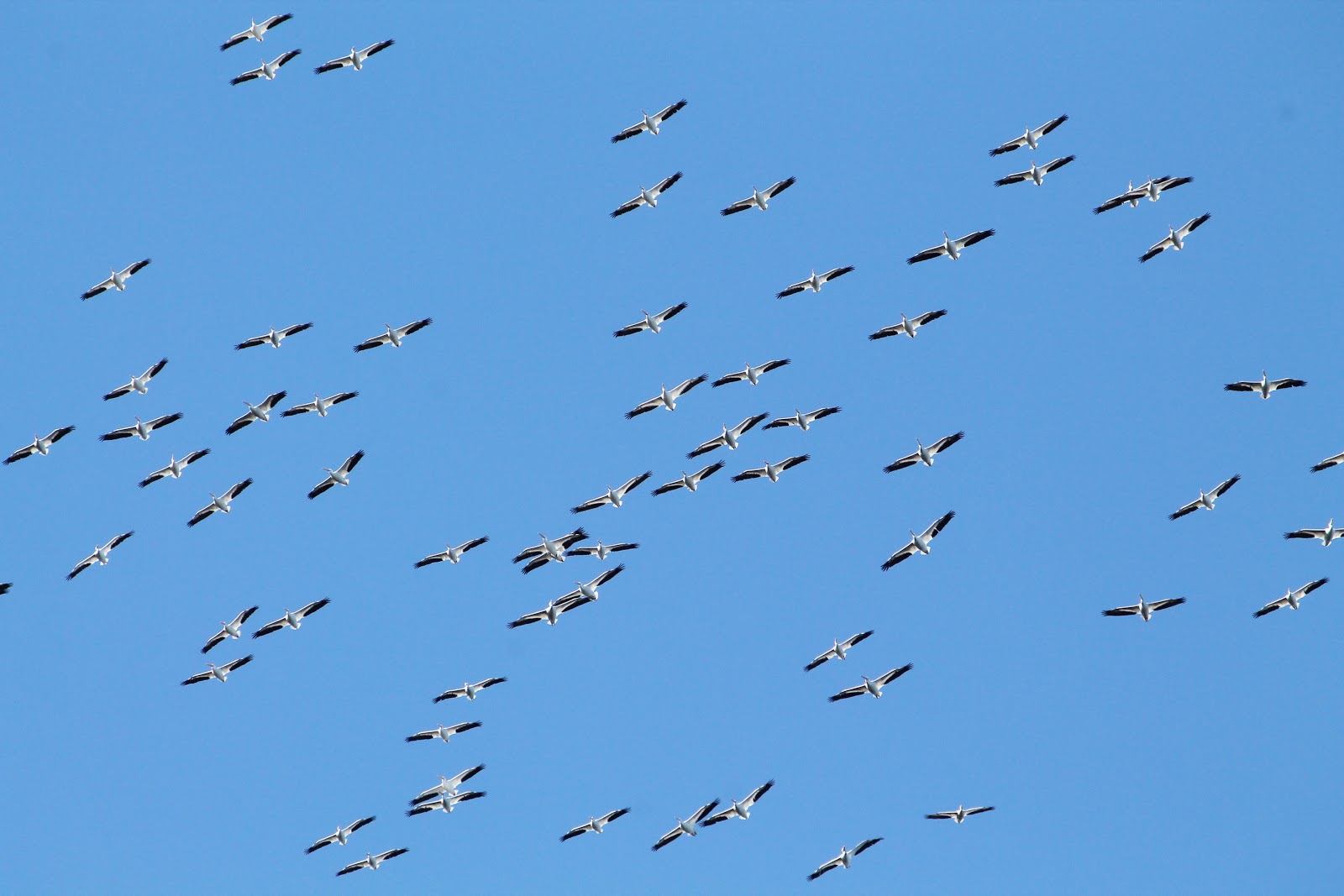
American White Pelicans soaring over the park.
(Taken 12/19/12, Myakka River State Park FL)

Tuesday, January 29, 2013

Red-Cockaded Woodpecker

Update 2/12/2013, check out this close up video of the Red-Cockaded Woodpecker, taken at Babcock-Webb Wildlife Management Area, Punta Gorda FL, on 2/10/2013 at dusk.

http://www.youtube.com/watch?v=E6c9Oa99vlQ&feature=youtu.be   

Today's featured feathered friend is the Red-Cockaded Woodpecker.  They can only be found in the southern United States and their conservation status is listed as "vulnerable".  It is estimated that only 12,500 individual birds remain, or about 1 percent of their original population.
     There are many locations along the Great Florida Birding Trail where the Red-Cockaded Woodpecker is known to exist.  Biologists at these locations mark trees with wide white paint rings that are easily spotted.  The "ringed" trees indicate active or potential nesting sites.  We have visited several of these Birding Trail locations with no successful sighting.
     Last week we traveled to Babcock-Webb Wildlife Management Area, south of Punta Gorda.  We were hoping to add this species to our life list, we were finally successful.  Just before sunset on Thursday, we heard and then spotted the Red-Cockaded Woodpecker.  We returned to Babcock-Webb on Friday, spending the entire day taking photos of birds, butterflies and nature.  At dusk, we revisited the location of the Red-Cockaded sighting.  Once again, we heard the bird's call, then spotted him.  Just as we had anticipated, he came back to the same tree, where we were able to get a photo along with a few nice videos.  
     Click on the links below to learn more about the trees that Red-Cockaded Woodpeckers select for nesting sites.  Learn how humans help this species survive by inserting artificial nesting boxes directly into trees.  Enjoy these photos of our outing.....tweet.....tweet!!

Red-Cockaded Woodpecker
(Taken 1/25/13, Babcock-Webb WMA, Punta Gorda FL)

Long Leaf Pine with artificial nesting box inserted.
(Taken 1/25/13, Babcock-Webb WMA, Punta Gorda FL)

Ringed tree indicating a nesting site.
(Taken 1/25/13, Babcock-Webb WMA, Punta Gorda FL)
http://www.allaboutbirds.org/guide/Red-cockaded_Woodpecker/id

http://en.wikipedia.org/wiki/Red-cockaded_Woodpecker

http://floridabirdingtrail.com/index.php/trip/trail/Fred_C._BabcockCecil_M._Webb_Wildlife_Management_Area/

Tuesday, January 22, 2013

Great Horned Owl - Master Predator

     Today's featured feathered friend is the Great Horned Owl.  They have the largest range of any North American Owl.  They can be found year round from the Arctic to the southern most parts of South America.  They are the third largest Owl of the Americas, behind the Great Gray and Snowy, and the second heaviest behind the Snowy.
     The Great Horned is a very large Owl, with a rectangular head, large body and widely spaced ear tufts (Note: the ear tufts are simply tufts of feathers on their crowns, they are NOT ears).  Adults have yellow eyes, broad reddish-brown to gray facial disk, dark barring on belly with feathered legs and feet.  Females are larger than males, otherwise they are similar in appearance.  The chicks are covered with fluffy white down.  Juveniles are like adults but lack ear tufts and maintain much of the down on their heads.  There are many subspecies of Great Horned Owls, so their coloration and size differs by  region.  Generally, they are 22 inches in length, weigh just over three pounds with a wingspan of 49 inches.
     The Great Horned Owl is the only bird that hunts and consumes skunks.  Check out the links provided below for the vast listing of it's potential prey, and much more fascinating information about this interesting species.  Enjoy these photo of a master predator, the Great Horned Owl.....tweet.....tweet!!

Adult Great Horned Owls at the nest.
(Taken 1/22/13, Punta Gorda FL)
(Chick is visable on the nest)

Great Horned Owl chicks
(Taken 1/22/13, Punta Gorda FL)

Great Horned Owl
(Taken 2/16/12, Our neighbor's backyard)

http://www.allaboutbirds.org/guide/Great_Horned_Owl/id

Tuesday, January 15, 2013

Limpkin

     Today's featured feathered friend is the Limpkin.  Found throughout Central and South America, the Limpkin reaches it's northernmost range in Florida and the swamps of southern Georgia.
     A large bird with a heron like appearance, it is dark brown overall with white triangular marks over most of it's body.  The markings are more dense on it's head and neck.  It has a long, slightly downcurved bill.  Limpkins are 25 to 29 inches in length with a 40 to 42 inch wingspan and weigh about 2 1/2 pounds.  Males and females are similar in appearance, juveniles are similar to adults, but paler brown.
     Roughly 70 percent of the Limpkins diet is made up of Apple Snails.  Using their long bill the snails are easily and quickly extracted usually without breaking the shell. 
     Limpkins were nearly eradicated from Florida by human hunting.  Over the last 20 years they've made a pretty good come back.  We have little trouble spotting them on an outing to their preferred habitat.  Click on the links below for more information and listen to the Limpkin's call.  Enjoy these photos of the Limpkin.....tweet.....tweet!! 
    
This Limpkin is planning it's next move.
(Taken 1/6/13, Celery Fields, Sarasota FL)

Limpkin
(Taken 11/8/12, northern tip of Lake Okeechobee FL)

Limpkin
(Taken 12/10/12, Lettuce Lake Park, Tampa FL)

http://www.allaboutbirds.org/guide/Limpkin/id

http://en.wikipedia.org/wiki/Limpkin