Saturday, May 25, 2013

Swallow-Tailed Kite

     Today's featured feathered friend is the Swallow-Tailed Kite.  With it's "scissor-tail" and distinctive black and white plumage, it's presence is exciting and unforgettable.  It's head and body are white, it's wings, tail, feet and bill are black.  It's tail alone is over a foot long.  Adults and juveniles are similar in appearance, although younger birds have shorter tails.  Their average length is 23 inches, their average wingspan is 48 inches and their average weight is slightly more than one pound.
     These striking raptors are native to South America, but many migrate to the United States each spring for a breeding season which takes place from March to May.  They can be found in all of the Gulf Coast states and as far north as the Carolinas.  In late summer and early fall, as many as 2,000 birds gather together in the same place (a staging area) before heading south for the winter.
     Swallow-Tailed Kites are very fascinating birds.  They rarely flap their wings in flight, however, they constantly rotate their tails to maintain a heading or to make sharp turns.  They glide low over water and then skim the surface with their bill to get a drink.  They sometimes eat while in flight.  Their call is more like that of a songbird than a raptor, yet they are mostly silent.
     This graceful bird was chosen as the symbol for The Great Florida Birding Trail (GFBT).  It's image adorns road signs state-wide, signifying stops along the Trail.  The GFBT is a network of over 500 sites throughout Florida selected for their excellent birdwatching, wildlife viewing or educational opportunities.
     The Swallow-Tailed Kite certificate (Level 5, Elite) from the Wings Over Florida Program is the highest level that can be reached.  It is awarded after a birder scores 350 Florida species.  We are now less than 50 birds away from reaching our Level 3 (Advanced, 250 Florida species) certificate.
     Click on the links provided for more information about the Swallow-Tailed Kite and the GFBT.  Enjoy these photos taken from our backyard.....tweet.....tweet.
 
Swallow-Tailed Kite
(Taken 6/3/12)
 
Swallow-Tailed Kite
(Taken 5/10/13)


GFBT Road Sign found throughout Florida
http://www.allaboutbirds.org/guide/Swallow-tailed_Kite/id

http://en.wikipedia.org/wiki/Swallow-tailed_Kite


Friday, May 17, 2013

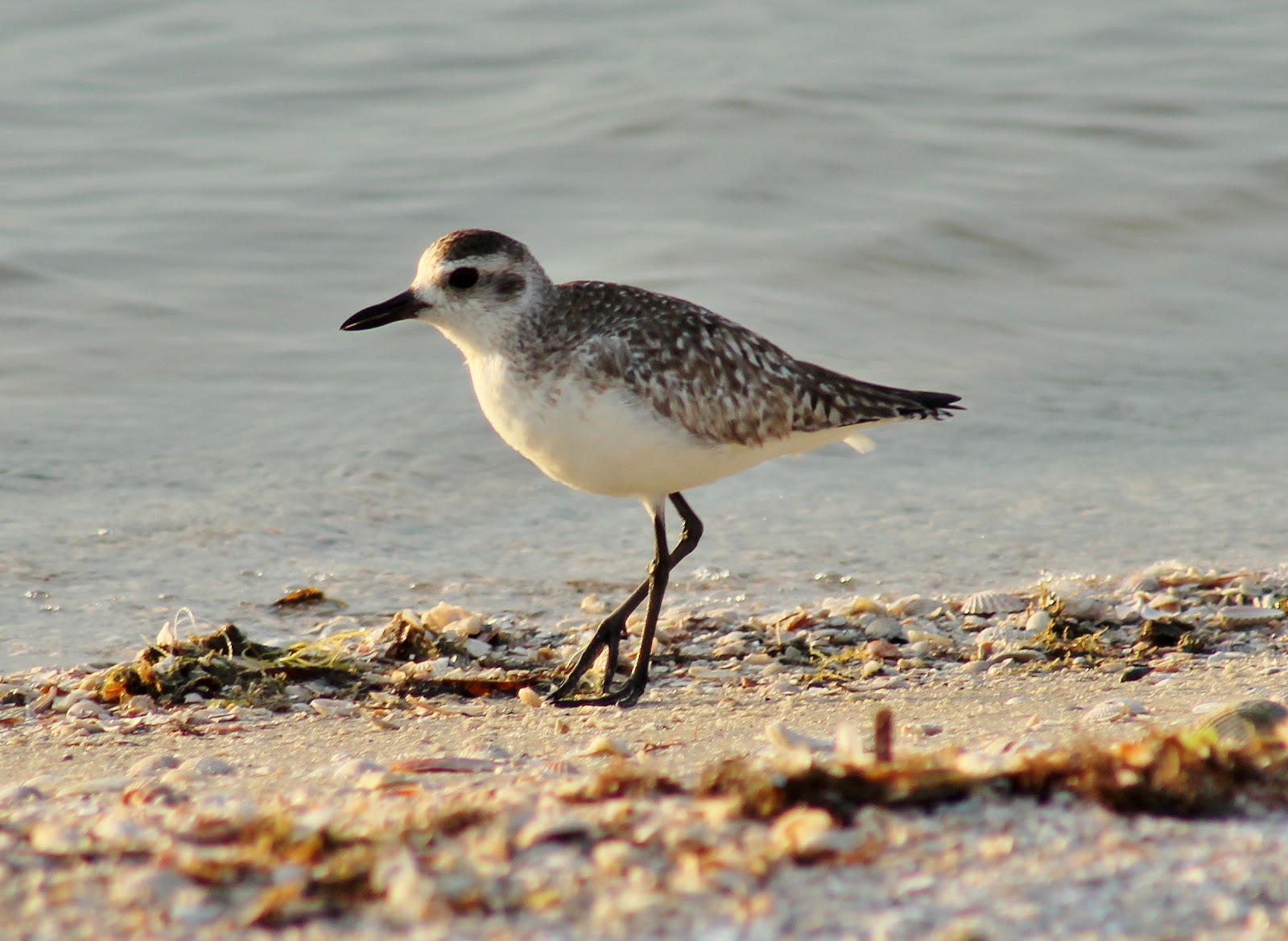
Black-Bellied Plover

     Today's featured feathered friend is the Black-Bellied Plover.  Also known as the Gray Plover, it is the largest plover in North America.  Their average length is 11.25 inches, the average wingspan is 23.5 inches and they weigh between 6 and 9 ounces.
     Black-Bellied Plovers molt into their non-breeding (winter) plumage by early September and retain it through the following April.  Their winter plumage is a fairly plain gray above, with a gray speckled breast and a white belly.  In spring and summer, they change back into their breeding (summer) plumage.  Adult males have a striking black neck, throat, breast and upper belly.  The black contrasts  with a vivid white stripe running down the sides of the neck to the wings, the rump is bright white.  Adult females can be just as colorful or much more subdued.  Juveniles and first year birds resemble adults in winter plumage.    
     Black-Bellied Plovers are long-distance migrants, making non-stop flights over Asia, Europe and North America.  However, they are rarely seen in the interior of these continents, landing only if forced down by severe weather, or to feed on the shores of very large lakes.  Their summer breeding grounds are in the Arctic areas of Canada, Alaska and Russia.  When not on their breeding grounds they are abundant on coastlines around the world.
     Enjoy these photos of the Black-Bellied Plover.....tweet.....tweet!!

In Summer (Breeding) Plumage
(Taken 5/16/13, Boca Grande Beach, Gasparilla Island FL)

In Winter (Non-Breeding) Plumage
(Taken 2/7/13, Indian Mound Park, Englewood FL)

Changing into Summer (Breeding) Plumage
(Take 4/11/13, Ft. Desoto Park, St. Petersburg FL)


In Summer (Breeding) Plumage
(Taken 5/16/13, Boca Grande Beach, Gasparilla Island FL)
 http://www.allaboutbirds.org/guide/Black-bellied_Plover/id

http://en.wikipedia.org/wiki/Grey_Plover

Saturday, May 11, 2013

Bachman's Sparrow

     Today's featured feathered friend is the Bachman's Sparrow.  Although a year round resident, determining their presence in the winter is difficult because of it's seclusion and inactivity.  However, in the spring they are very active.  Breeding season usually starts in March lasting through mid-summer.  That's when breeding males can be seen singing from low and exposed perches.  
     It is a large sparrow with reddish-brown and gray streaked upperparts, with buffy underparts contrasting with a whitish belly.  It's face is gray with a brown crown and a thin dark line extending back from it's eye.  The tail is long, dark and round-tipped.  It's legs and feet are pink.  Males and females are similar in appearance.  Juveniles are like adults but with black streaking on the breast and crown.
     The Bachman's Sparrow is endemic to the southeastern United States, meaning, they can't be found anywhere else on earth.  Their range includes Virginia to Missouri in the north, parts of eastern Texas to the west, as well as all of the Atlantic and Gulf coast states.  Birds in the northern parts of this range migrate south for the winter.  Their conservation status is Near Threatened, with habitat loss as the biggest factor cited for it's declining population.
     We had read of sightings as early as February this year at the Babcock-Webb WMA, south of Punta Gorda.  On May 10th, we made the short trip and scored our 203rd Florida bird.  Enjoy these photos (and a video) of the elusive Bachman's Sparrow.....tweet.....tweet!! 

Click here for the video---->   http://youtu.be/obmocEMeiRM

Bachman's Sparrow
(Very first photo of our 203rd Florida bird)
 
Bachman's Sparrow singing a beautiful song.
http://en.wikipedia.org/wiki/Bachman's_Sparrow

http://myfwc.com/viewing/recreation/wmas/lead/fred-babcockwebb/wildlife/

Wednesday, May 1, 2013

Our 200th Florida Bird - Spring Migration Almost Over?

     Spring migration has slowed to a crawl, however, April was still a fantastic month for birding.  Migrating birds passed through Florida in massive numbers on the way to their summer breeding grounds.  Since the April 3rd "fallout", winds have been favorable for the birds to move north.  We've had a few showers and light winds over the past four weeks, yet not severe enough for another fallout.  Regardless, birds continue to cross over the Gulf of Mexico, stopping to rest and refuel once they reach land.
     Since our April 8th posting, we've added nine new species.  We scored with the Cape May, Bay-Breasted and Blackpoll Warblers, the Great Black-Backed Gull, the Common Nighthawk and the Bobolink.  We also scored on the beach with three new shorebirds, the Snowy Plover, the Red Knot and our 200th Florida Bird, the Wilson's Plover. 
      In all, we added 15 new birds to our life list in April.  Enjoy these photos of our most recent sightings.....tweet.....tweet!!   
Cape May Warbler (Male)
(Taken 4/18/13, Anna Maria Island FL)

Bay-Breasted Warbler (Male)
(Taken 4/18/13, Anna Maria Island FL)

Blackpoll Warbler (Male)
(Taken 4/19/13, Anna Maria Island FL)
 
Great Black-Backed Gull
(Taken 4/19/13, Longboat Key FL)

Snowy Plover
(Taken 4/19/13, Longboat Key FL)

Wilson's Plover - Our 200th Florida Bird
(Taken 4/24/13, Ft. DeSoto Park, St. Petersburg FL)


Monday, April 15, 2013

Red-Headed Woodpecker

     Today's featured feathered friend is the Red-Headed Woodpecker.  Adult male and female Red-Headed Woodpeckers are identical.  Their head and neck is Crimson red, their back and tail is black and their underparts are snowy-white.  The wings are black with white secondary feathers.  Juveniles are similar but, are mottled with brown.  The Red-Headed is a medium-sized Woodpecker measuring about 9 1/2 inches in length, with a 16 1/2 inch wingspan and weighs about 3 ounces.
     Their conservation status is Near Threatened.  Once common, their numbers are in decline due to habitat loss and changes in their food supply.  They are year-round Florida residents and their range includes most of the eastern United States, however, they are difficult to find.  We had asked several local birders where to locate them.  With the location in hand, we still only managed to find them after an exhaustive search.  We've also searched for them at known "hotspots", with no luck.
     Non-birders often misidentify the Red-Bellied Woodpecker as a Red-Headed.  Both are the same size and have red on their heads but, the similarity ends there.  The Red-Headed's "entire" head is a crimson red, while the Red-Bellied has a bright red stripe on it's nape and crown (back and top of the head).  The Red-Headed has solid colors while the Red-Bellied has black and white barring on it's wings and back.  Enjoy these photos of the gorgeous and elusive Red-Headed Woodpecker.....tweet.....tweet!!


Red-Headed Woodpecker
(Taken 4/5/13, Clay Gully Road, Myakka City FL)


Male Red-Bellied Woodpecker (for comparison)
(Photo taken 2/21/13, Alligator Creek Preserve, Punta Gorda FL)
(Red stripe on white head, also note the red belly)

http://www.allaboutbirds.org/guide/red-headed_woodpecker/id

Monday, April 8, 2013

The Fallout

     On Wednesday, April 3rd, 2013, a storm passed across the Gulf of Mexico.  This early spring storm created a phenomenon in the birding world known as a "fallout".  Fallouts occur when migrating birds encounter weather conditions that cause them to become temporarily grounded.  The birds are literally beaten up by high winds and hard rain while in flight.  They seek food and shelter at the first sign of land.  Bad for the birds but, great for birders who jump at the opportunity to see many species and large numbers of birds.
     From Ft. Desoto in the North to Sanibel Island in the South, migrating birds are still being seen in large numbers.  Not wanting to miss the fallout, we traveled to Ft. Desoto on Saturday morning, April 6th, before first light.
     Upon arriving, we immediately spotted several Hooded Warblers and an Orchard Oriole.  Later, we spotted a Blue-Winged Warbler, a Prothonotary Warbler and a Yellow-Billed Cuckoo.  Along the shoreline we spotted a Long-Billed Curlew.  Although we saw many, many other birds, these six are all life list birds for us.  Our life list now stands at 191 species.
     Spring migration is just beginning, so we'll be checking the weather forecast for the rest of the month.  If another "fallout" occurs, we'll be ready!!  Enjoy these photos of our six newest life lists birds from Ft. Desoto Park.....tweet.....tweet!!   

Hooded Warbler (Male)

Hooded Warbler (Female)

Orchard Oriole

Blue-Winged Warbler

Prothonotary Warbler

Yellow-Billed Cuckoo

Long-Billed Curlew

http://floridabirdingtrail.com/index.php/trip/trail/Fort_De_Soto_Park/