Sunday, March 10, 2013

Painted Bunting - One of God's Most Colorful Creations

     Today's featured feathered friend is the Painted Bunting.  Painted Buntings are small songbirds of the Cardinal family.  They measure just over 5 inches in length and weight less than one ounce.
     The male Painted Bunting is undoubtedly the most colorful bird in North America.  He has a blue head, red underparts and a green back.  Females and immatures are a bright yellow-green overall, with a pale eye ring.  Because of their dazzling plumage, males are caught and sold illegally as cage birds, particularly in Mexico and the Caribbean.  Their conservation status is Near Threatened.  
     Their summer range includes the southern most states and the Carolinas.  They migrate through Mexico and Florida on the way to their wintering grounds in Central America and the Caribbean.  We have been blessed to have them stop by our backyard for a seed and a bath each year since we moved to Florida. 
     Click on this link  http://www.youtube.com/watch?v=r-IJtSL4oAo&feature=youtu.be  to watch a short video of a male Painted Bunting.  Enjoy the photos of these stunning birds.....tweet.....tweet!!
 
Male Painted Bunting enjoying a bath.
(Taken 3/10/2012, Our Backyard)

Female Painted Bunting blending into the greenery.
(Taken 1/12/13, Our Backyard)

Male Painted Bunting striking a pose.
(Taken 3/8/13, Our Backyard)

Female Painted Bunting
(Taken 12/24/12, Our Backyard)
http://www.allaboutbirds.org/guide/Painted_Bunting/id

Tuesday, March 5, 2013

Roseate Spoonbill and Friends

Click here to view this photo book larger

Six New Birds - A Big Day in Hendry County

     On Saturday, March 2nd, we took a birding trip to Stormwater Treatment Area 5 (STA-5) in Hendry County, south of Clewiston.  The event was sponsored by the Hendry-Glades Audubon Society.  We were hoping to add five new birds to our life list on this trip, we scored six.  A "Big Day" for us, bringing our life list to a total of 177 different species.
     There were over 100 birders present on site.  Each vehicle entering the area was given a walkie-talkie and birders were asked to "call out" if they saw any interesting species.  We were less then five minutes on the trail when the lead vehicle in our group spotted a Peregrine Falcon atop a power pole.  Everyone stopped, got out of their cars, and quickly began setting up their spotting scopes.  It seemed as though we were the only photographers on the trip.  We took as many photos of the Peregrine as we could, then moved on.
Peregrine Falcon (in poor morning light at a distance)
     STA-5 is a very large area created to filter water flowing into the Everglades.  It is an extensive system of levees, dikes and canals, creating very large impoundment ponds (cells).  Driving atop the levees overlooking the water, hundreds of birds are visible in every cell.  The majority of birds are those typically found around water.  Wading birds, diving ducks, dabbling ducks, shorebirds, gulls and terns were all abundant.  A few warbler species were spotted along with grackles and Red-Winged Blackbirds.   On one particular stop, we scored three life list birds.  A pair of Snail Kites were foraging for apple snails on a grassy patch next to a pair of sleeping Fulvous Whistling-Ducks.  A pair of Purple Swamphens were foraging at the edge of the tall grass and reeds.  Here are photos taken on this stop.  An impressive array of optical equipment can be seen.
Snail Kite on the wing.
Fulvous Whistling-Duck (we spotted over 30 of them)
 
Purple Swamphens (this pair spotted with their chicks)

Our Group (one of many at STA-5 on March 2nd)
     Later, at another stop, we spotted (through someone's scope) a male Ruddy Duck.  We couldn't find him in the vast sea of American Coots and other duck species, so we didn't get a photo.  We missed out on spotting the  Gadwall (a duck species) even though it was "called out" several times.
     As we were leaving the area heading for home we spotted a Western Kingbird, scoring our sixth new bird of the day.  We traveled over 280 miles, the temperatures were in the low 50s and the winds were brisk and steady.  Nevertheless, we had a fantastic birding day.  In all, we spotted 63 species.  We hope you enjoy these photos of our trip.....tweet....tweet!!
Western Kingbird (a rare bird in the east)
http://floridabirdingtrail.com/index.php/trip/trail/Stormwater_Treatment_Area_5/

Friday, February 22, 2013

Wings Over Florida

     On December 27th 2012, on an outing to the Celery Fields in Sarasota, we spotted the Sora.  Finally, we had scored our 150th Florida bird and earned our "Scrub-Jay" level certificates from "Wings Over Florida". 
     The Florida Fish and Wildlife Conservation Commission (FWC) administers the Great Florida Birding and Wildlife Trail (GFBWT).  This 2,000-mile, self-guided highway trail features over 500 sites covering the eastern, western, southern and panhandle sections of Florida.  We have visited over 40 of these Birding Trail sites and countless other parks, lakes and ponds.  
     The Birding and Wildlife Trail oversees the Wings Over Florida program.  Birders can sign-up for free, print a checklist of Florida's birds, grab the necessary gear (survival, optical and digital) and start having fun.  Beautiful, frameable certificates are awarded at five different levels of achievement.  We had already photographed more than 80 species when we signed up for the program, so we applied for and received our "Cardinal" level certificates right away.  In just over two years, we now have over 170 species of Florida's birds on our list.  We are well on our way to the next level, the "Black-Skimmer" level, which requires 250 Florida birds. 
     Our next planned outing is to the Stormwater Treatment Area 5 (STA-5), south of Lake Okeechobee early next month.  We're hoping to score at least five life list birds on the trip.  Click on the links below to visit the FWC, GFBWT and Wings Over Florida websites for additional information.  Enjoy some of our photos taken along the trail.....tweet.....tweet!!

Our Wings over Florida Certificates
"Cardinal" Level - 50 Florida Birds
"Scrub-Jay" Level - 150 Florida Birds
SORA  -  Our 150th Bird Scored
 
Looking for a new species at Oyster Creek Regional Park
in Englewood FL.

 Searching for the rare Florida Scrub-Jay in
 Shamrock Park, Venice FL.

http://myfwc.com/

http://www.floridabirdingtrail.com/

http://floridabirdingtrail.com/index.php/resources/wings/


Thursday, February 14, 2013

Love Birds ~ Happy Valentine's Day

     In honor of Valentine's Day, our featured feathered friends are Love Birds.  Mating season is already underway.  Rookeries throughout Florida are filled with nesting Herons and Egrets.  Bald Eagles and Great Horned Owls are already raising their chicks.  Songbirds are carrying materials out of the yard to build their nests.  Cardinals and Mockingbirds are in full song searching for a mate.    
Today, we embrace Love.  Enjoy the Love Bird photos.....tweet.....tweet!!  Happy Valentine's Day.

Northern Cardinals
(Taken 6/30/11, Our backyard)

Florida Scrub-Jays
(Taken 3/24/12, Our backyard)
  
Great Blue Herons
(Taken 2/2/12, The Rookery, Venice FL)


Wednesday, February 6, 2013

Brown Pelican

     Today's featured feathered friend is the Brown Pelican.  Although a large bird by any measure, it is the smallest of the world's eight Pelican species.  The American White and the Brown are the only Pelicans native to North America.  The Brown Pelican is the state bird of Louisiana.
     Once a threatened species, Brown Pelicans are now abundant on both U.S. coastlines with a large population in the Gulf of Mexico.  They can also be found along the coastlines of Mexico, the Caribbean Islands, Central America and the northern parts of South America.
     The Brown Pelican is a large water bird with a long bill (up to 13 inches) and large pouch typical of Pelicans.  They are between 42 and 54 inches long, weigh from six to twelve pounds and have a wingspan of up to eight feet.  Males and females are similar in appearance with brown bodies and white heads.  The head, neck, bill, pouch and eye color can vary with season and breeding status.  Juveniles are similar to adults, except with brown heads.
     Unlike American White Pelicans who "corral" their food, Brown Pelicans dive head first into the water to feed.  They are graceful fliers and often form long, single-file lines, gliding just inches over the surface of the water.  Click on the links below for more information and enjoy these photos of the Brown Pelican.....tweet.....tweet!!

Brown Pelican (Adult)
(Taken 2/16/11, Placida FL)

Brown Pelican (Juvenile)
(Taken 1/26/13, Lemon Bay, Englewood FL)

Brown Pelicans diving for food.
(Taken 12/15/12, Anna Maria Island FL)
 
American White Pelican and Brown Pelican
(note the size difference)
(Taken 12/15/12, Anna Maria Island FL)
http://www.allaboutbirds.org/guide/Brown_Pelican/id

Sunday, February 3, 2013

American White Pelican

     Today's featured feathered friend is the American White Pelican.  Of the eight Pelican species on earth, only the Brown and the American White are native to North America.  
      The American White Pelican is a large white water bird with a long bill (nearly 12 inches) and a large pouch typical of Pelicans.  Males and females are similar in appearance although males are generally larger.  Their overall length (tip of bill to tip of tail) is from 50 to 70 inches and they weigh between 10 to 20 pounds.  Their eight to ten foot wingspan makes them the second largest flying bird in North American, behind the California Condor.  Their black wing tips are only visible in flight.
     Their summer breeding grounds are west of the Mississippi River to the Pacific Northwest, from Colorado to northern Canada.  In the winter they migrate to parts of California,  Arizona, the Gulf Coast states and south to Panama.  They begin arriving for the winter in our area by late October and start returning north by early April. 
     Unlike Brown Pelicans who feed by diving head first into the water to catch fish, American White Pelicans mostly feed in cooperative groups.  They form lines or circles, pushing or driving fish into shallower water, then duck their heads into the water to catch the fish.  Enjoy these photos of our largest wintering bird, the American White Pelican.....tweet.....tweet!! 

American White Pelican making a water landing.
(Taken 12/15/12, Coquina Baywalk on Leffis Key, Anna Maria Island FL)

American White Pelicans in a feeding formation.
(Taken 1/4/13, Ackerman Park, Sarasota FL)

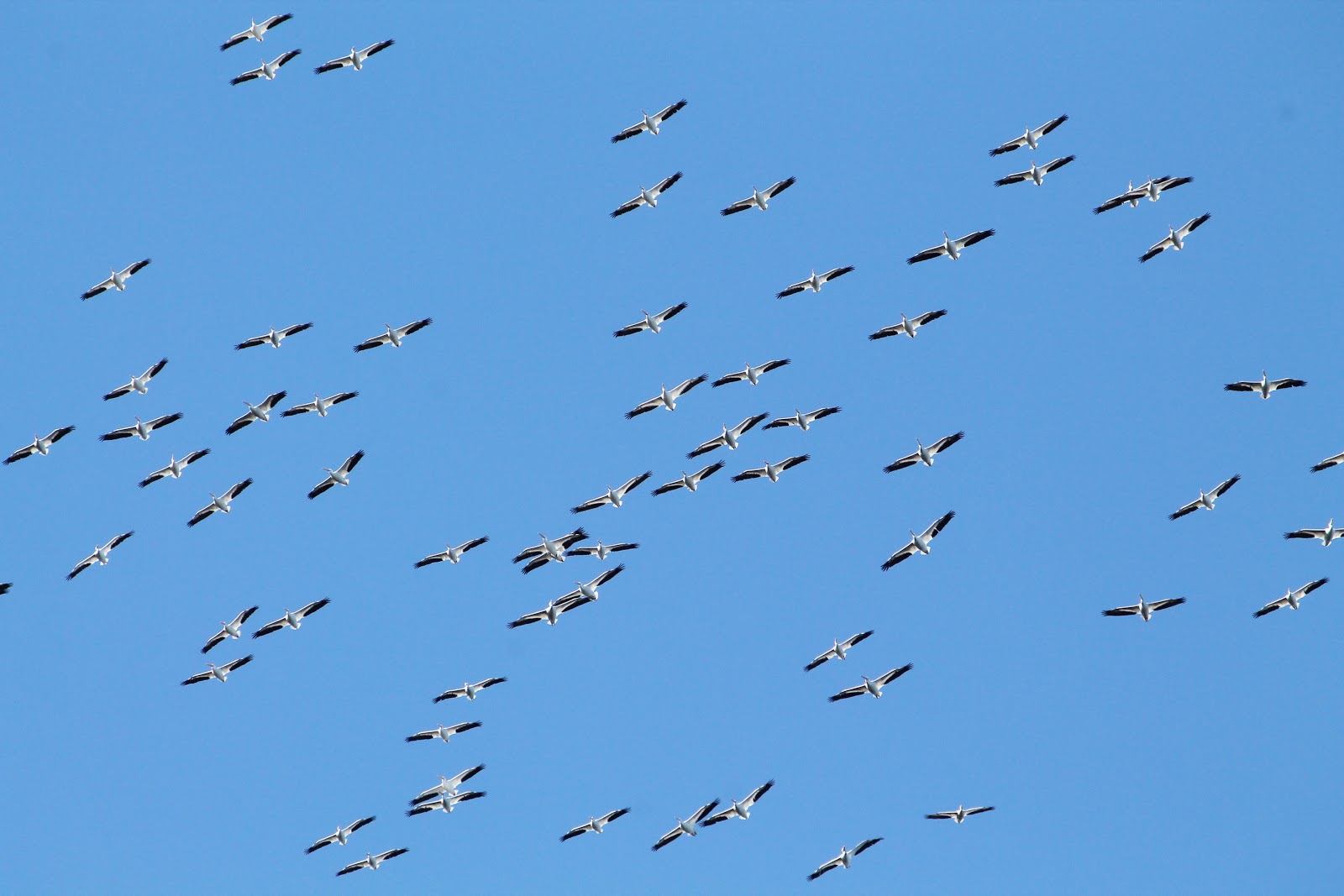
American White Pelicans soaring over the park.
(Taken 12/19/12, Myakka River State Park FL)